
Building in Phuket: What You Need to Know Before Starting Your Dream Villa or Commercial Project
Phuket is one of Southeast Asia’s premier locations for luxury residential villas, branded resort residences, and prime commercial developments. However, taking a development from a raw land acquisition through to practical handover involves navigating intricate environmental zoning laws, coastal building setbacks, and severe tropical microclimates.
Success requires thorough pre-construction due diligence and disciplined site execution. Whether you are an overseas investor or an established commercial developer, understanding the regulatory, technical, and logistical fundamentals of building in Phuket protects your capital and prevents costly delays.
1. Selecting an Accountable Building Partner
The success of any structural build depends entirely on the technical capability and governance of your main contractor. The local building market varies widely—from labour brokers lacking engineering oversight to integrated civil contractors. When vetting a construction team, look for:
- In-House Civil & Structural Engineering: Builders capable of reviewing shop drawings, calculating structural loads, and running certified value-engineering exercises.
- Direct Trade Supervision: Dedicated on-site project managers and site engineers rather than disconnected multi-tier sub-contracting.
- Documented Structural Track Record: Verifiable case studies of completed multi-tier concrete frames, basement retention systems, and bonded post-tensioning.
- Transparent Billing Frameworks: Fully itemized Bills of Quantities (BOQ) with fixed unit rates and clear milestone-linked payment schedules.
2. Land Ownership Structures and Due Diligence
Thailand enforces strict regulatory frameworks governing foreign property acquisition. While foreign nationals cannot hold freehold land titles directly in their personal names, common structures used by developers and villa owners include:
- Registered Long-Term Leaseholds: 30-year contractual leases registered directly at the local Land Department, often structured with prepaid renewal options.
- Thai Operating Companies: Legitimate commercial entities where foreign investors hold equity in accordance with the Foreign Business Act.
- Direct Building Ownership: Foreign individuals can directly own the physical superstructure built atop leased land, creating distinct asset separation between land and building.
Always engage independent legal counsel to verify title deeds (favouring Chanote titles) and ensure registered right-of-way access before committing capital to architectural design.
3. Phuket Environmental Zoning and Building Regulations
Phuket is governed by specific ministerial regulations, environmental protection acts, and local municipal zoning laws that heavily regulate building envelopes:
- Coastal Setback Restrictions: Regulations divide beachfront zones into strict distance bands from the mean high-water mark, restricting overall building heights to between 6 and 12 metres.
- Slope & Elevation Envelopes: Land situated above 80 metres above sea level, or with natural slopes exceeding 35 degrees, faces stringent buildability limits or total construction prohibitions under environmental protection laws.
- Environmental Impact Assessments (EIA): Large-scale residential estates, hotels, and condominiums exceeding specific room or area thresholds must obtain formal EIA approval before any building permit (OrBorTor / Municipality) can be granted.
4. Designing for Coastal and Tropical Conditions
The Andaman marine climate demands structural and material engineering far beyond standard continental building practices:
- Aggressive Marine Salinity: Airborne chlorides corrode poorly protected rebar. Coastal concrete requires high-durability mix designs, anti-carbonation coatings, and minimum 40–50 mm cover depths.
- Monsoon Drainage Management: Sustained rainfall requires deep perimeter swales, oversized retention pits, and continuous waterproofing membranes along all below-grade basements and retaining walls.
- Thermal Mass & Cross-Ventilation: Deep roof overhangs, high-performance low-E double glazing, and optimized building orientation minimize solar heat gain and lower operational air conditioning loads.
5. Integrated MEP Engineering and Service Coordination
A structurally sound shell is only as good as its operating systems. Early coordination between the reinforced concrete framework and internal building services eliminates post-pour slab core-drilling and service clashes.
Integrating full MEP engineering design and infrastructure early ensures that heavy mechanical plant, vertical drainage stacks, three-phase electrical distribution, and backup generator systems are cast seamlessly into the primary structural frame.
6. Project Phasing and Milestone Delivery
Disciplined project management bridges the gap between architectural intent and day-to-day site productivity. A typical high-spec villa or commercial project follows structured sequential phases:
| Project Phase | Typical Duration | Key Deliverables |
|---|---|---|
| Permits & Mobilization | 2–4 Months | Municipal building permit, soil testing, site setup |
| Substructure & Groundworks | 2–4 Months | Bored piling, pile caps, retaining walls, basement slab |
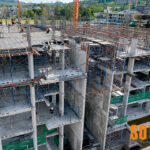
| Superstructure Frame | 4–6 Months | Reinforced concrete columns, post-tension slabs, roof frame |
| Architecture & MEP Fit-Out | 4–8 Months | Masonry walls, rough-in MEP, waterproofing, plastering |
| Finishing & Handover | 2–3 Months | Tiling, fixtures, testing and commissioning, snagging |
Following a rigorous planning workflow guarantees that financial schedules mirror actual site progress. Learn how we handle project governance from site assessment to practical completion across our structured construction process.
Engineering Precision for Developments in Phuket
From sub-base retaining systems and post-tensioned superstructures to turn-key mechanical and electrical installations, Sotech Asia delivers engineering leadership across residential and hospitality sectors.
Review our commercial and residential structural projects across the island on our completed projects page, or learn more about our corporate profile on our About Us page.
Planning a Construction Project in Phuket?
Connect with our engineering desk for zoning feasibility reviews, structural BOQ development, and reliable contracting services tailored to your build. Consult Our Engineering Team →